Beyond Qubits: How Quantum-Inspired AI Is Transforming Classical Computing Today | Prof. Tarik A. Rashid | Dr. Tarik Ahmed Rashid
Public Research / 4 Min Read
Beyond Qubits: How Quantum-Inspired AI Is Transforming Classical Computing Today
Introduction
The explosive growth of deep learning has revolutionised the technology landscape. But there are significant limitations in modern artificial intelligence:
-The need for enormous amounts of training data, huge energy consumption and high computational costs.
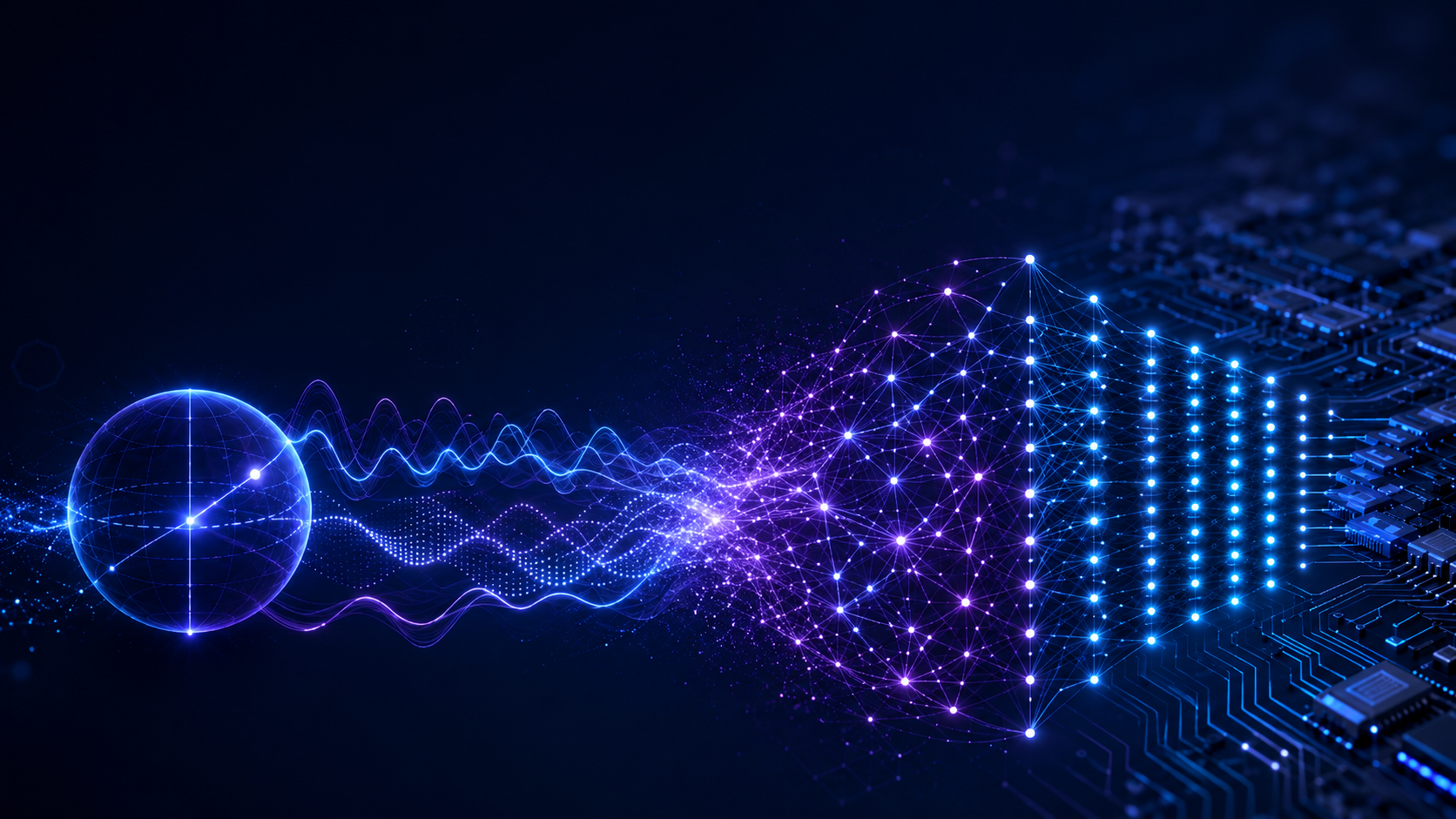
-As the scientific world anxiously waits for quantum computers to become fully functional, another intriguing and potent alternative option has emerged: Quantum-Inspired Neural Computing (QINC), combining the concepts of quantum mechanics with classical systems, which can result in the development of more intelligent, faster, and adaptable AI frameworks.
What is Quantum-Inspired Neural Computing?
Before exploring its potential, it is important to make a clear distinction between quantum systems and quantum-inspired approaches:
-True Quantum Computing: Needs physical qubits, specialised hardware and extreme operating conditions such as temperatures near absolute zero.
-Quantum-Inspired AI: Runs on conventional hardware. It does not use qubits at all; instead, it simulates quantum phenomena through classical algorithms, mathematical probability distributions, and amplitude-based weight representations.
The Core Advantages
The advantages are as follows:
-Immediate Implementation: QINC provides a practical test bed now, as it operates on existing classical hardware, making it accessible now rather than in some future research horizon.
-Avoidance of Quantum Fragility: It avoids present quantum hardware constraints, such as qubit instability and decoherence.
-Enhanced Classical Performance: QINC techniques measurably improve the efficiency and expressive power of conventional neural network architectures.
The Three Quantum Pillars of QINC: Quantum-inspired neural networks emulate three fundamental quantum behaviours within a classical computational framework:
-Superposition and Parallel State Evaluation: These networks take a more distributed approach to processing than binary inputs (0 or 1), instead evaluating multiple pathways or states of computation in parallel by using weight distributions and probability amplitudes. This enables a richer, more distributed representation of information than conventional binary processing allows.
-Entanglement-Like Variable Interactions: In quantum physics, entangled particles exhibit tightly correlated behaviour regardless of distance. QINC approximates this effect through simulated quantum gates, such as Controlled-NOT transformations (CNOT), which create complex, non-linear interactions among variables. These interactions capture aspects of data uncertainty and inter-feature relationships that traditional network architectures struggle to model.
-Probabilistic Output and Uncertainty Quantification: The probabilistic nature of output enables a natural evaluation of the classification uncertainty by using layers based on quantum-inspired models that are generative and discriminative.
Core Architectures and Optimisation Applications
QINC manifests in several concrete architectural forms, each addressing a distinct class of computational challenge:
-The Quantum-Inspired Hopfield & Boltzmann Networks: The neurons in these networks are replaced by quantum spins, greatly improving the amount of memory stored and the resilience to errors while recalling a pattern.
-Metaheuristic Optimisation Algorithms: Traditional optimisation algorithms can be significantly enhanced with quantum-inspired logic. For example, using the actual quantum-enhanced sampling instead of Gaussian noise in standard search equations greatly enhances global space coverage.
-Quantum Kernel Methods: These methods map classical input data into exponentially large Hilbert feature spaces, which increases the separation between overlapping data points and enables linear separation and classification in very complex patterns by Machine Learning models.
Real-world Applications and Optimisation Techniques
To describe the real-life applications and optimisations for this concept, the principles go beyond and transform classical AI structures to solve hard problems:
-Improved Neural Networks: Models such as the Hopfield network and Boltzmann networks have memory capacity so large that they exhibit quantum characteristics, thus allowing for more memory and improved resistance to error in pattern retrieval.
-Smarter Optimisation: Traditional search algorithms can become stuck looking for the best solution, which is what Smarter Optimisation can help resolve. The quantum-inspired logic enables algorithms to "tunnel" through data obstacles, giving them a better chance of finding the optimal answers in large data spaces.
These methods can map classical data into expanded higher-dimensional feature spaces, which allows AI models to make clear distinctions between overlapping, highly complex data points.
Current Realities and Challenges
While the potential of QINC is vast, the field faces distinct boundaries as it scales toward mainstream commercial use. Each challenge below is paired with its impact on current systems:
-Theoretical Standardization - Limited unified frameworks exist to mathematically solidify the field.
-Scalability Concerns - Simulating quantum principles on classical chips can struggle when transitioning to highly noisy, real-world data.
-The "Genuine Advantage" Gap - Ongoing research must constantly strive to prove that quantum-inspired methods outperform highly optimised traditional algorithms.
Looking Ahead
Quantum-inspired neural computing exists in its sweet spot. It serves as an immediate upgrade to modern, classical AI, and it lays the groundwork for the theory of quantum computers. Bringing these cross-disciplinary concepts from physics and computer science together is not merely an academic endeavour; it's a viable avenue towards scalable, intelligent systems. True quantum hardware is still scaling, but Quantum-Inspired AI is here today.
Further Reading
Moolchand Sharma, Nebojsa Bacanin, Tarik Ahmed Rashid. Quantum-Inspired Neural Networks: Future Perspectives and Challenges. Taylor & Frances, CRC Press. 2026. https://doi.org/10.1201/9781003682950