Graph Neural Networks (GNNs): The Ultimate Future of Artificial Intelligence | Prof. Tarik A. Rashid | Dr. Tarik Ahmed Rashid
Public Research / 5 Min Read
Graph Neural Networks (GNNs): The Ultimate Future of Artificial Intelligence
INTRODUCTION
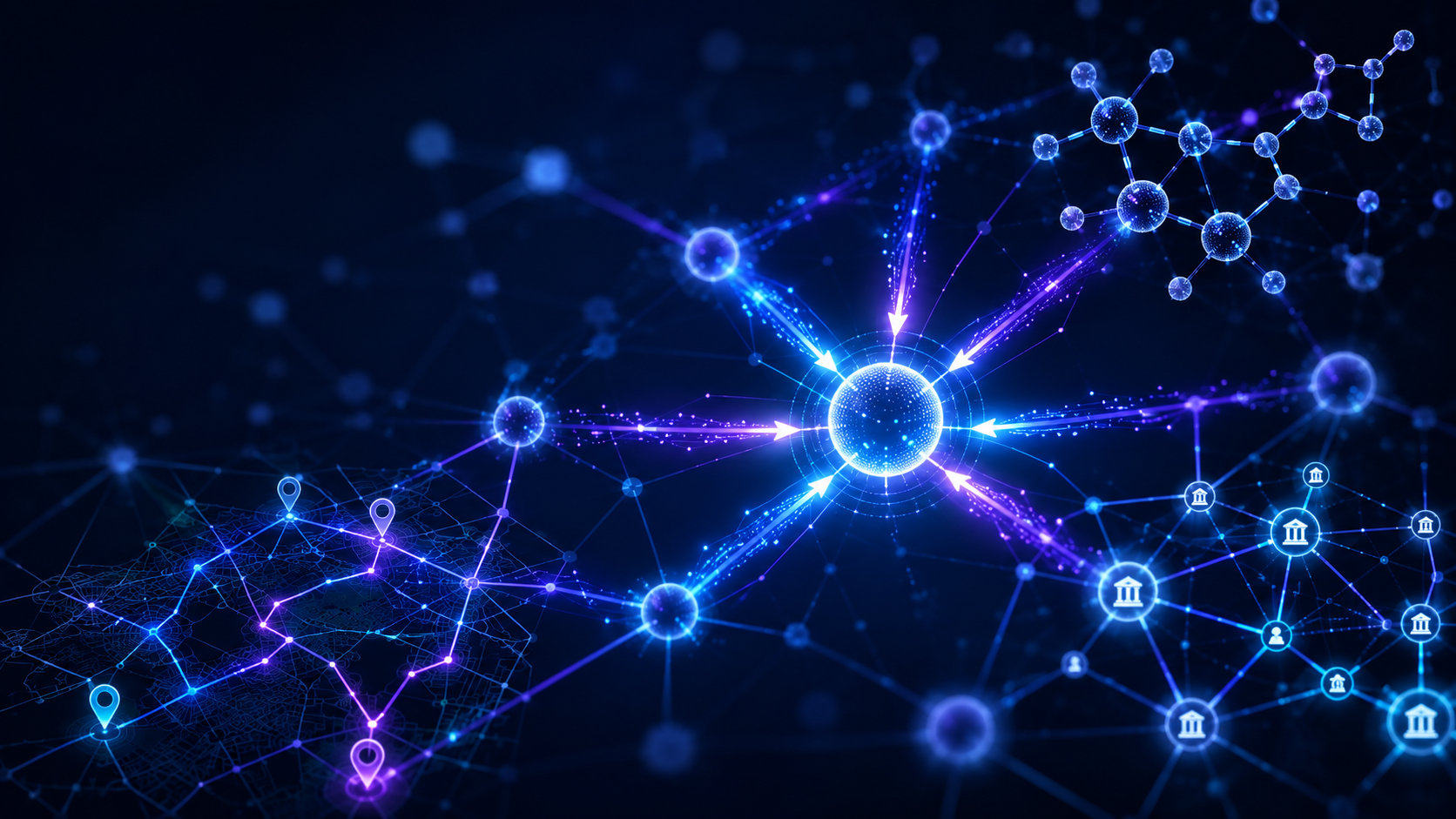
The data that we are dealing with daily is not all stored in a spreadsheet. Imagine your social media contacts, the route map you use, the molecules in a life-saving drug or the financial transactions in global banks. This data isn't flat; it's relational. It is made up of entities and the complex relationships between them. Historically, these networks were not easy to master with the traditional deep learning approach, which has completely dominated grid-like data such as images or text. GNNS is a step into the world of the most powerful and promising advancements in the field of artificial intelligence today.
What Exactly Is a Graph Neural Network?
Before diving into the concept of a GNN, it is important to understand the meaning of a graph in computer science. Graphs are a data structure comprised of two principal components:
-Nodes (or Vertices): The entities (e.g., people, proteins, cities, or web pages).
-Edges: The links or relationships between those entities (e.g., friendships, chemical bonds, roads, or hyperlinks).
Traditional neural networks (such as convolutional neural networks used for images) require inputs to be regular and structured, such as a tidy array of pixels. But graphs are not regular; they can be any size, and they are not ordered. Graph neural networks are deep learning models that are optimised to "consume" these complex and irregular graph structures. They enable AI to consider a data point not on its own, but in the full context of neighbouring data points and the full network around it.
How Do GNNs Learn? The Power of "Message Passing"
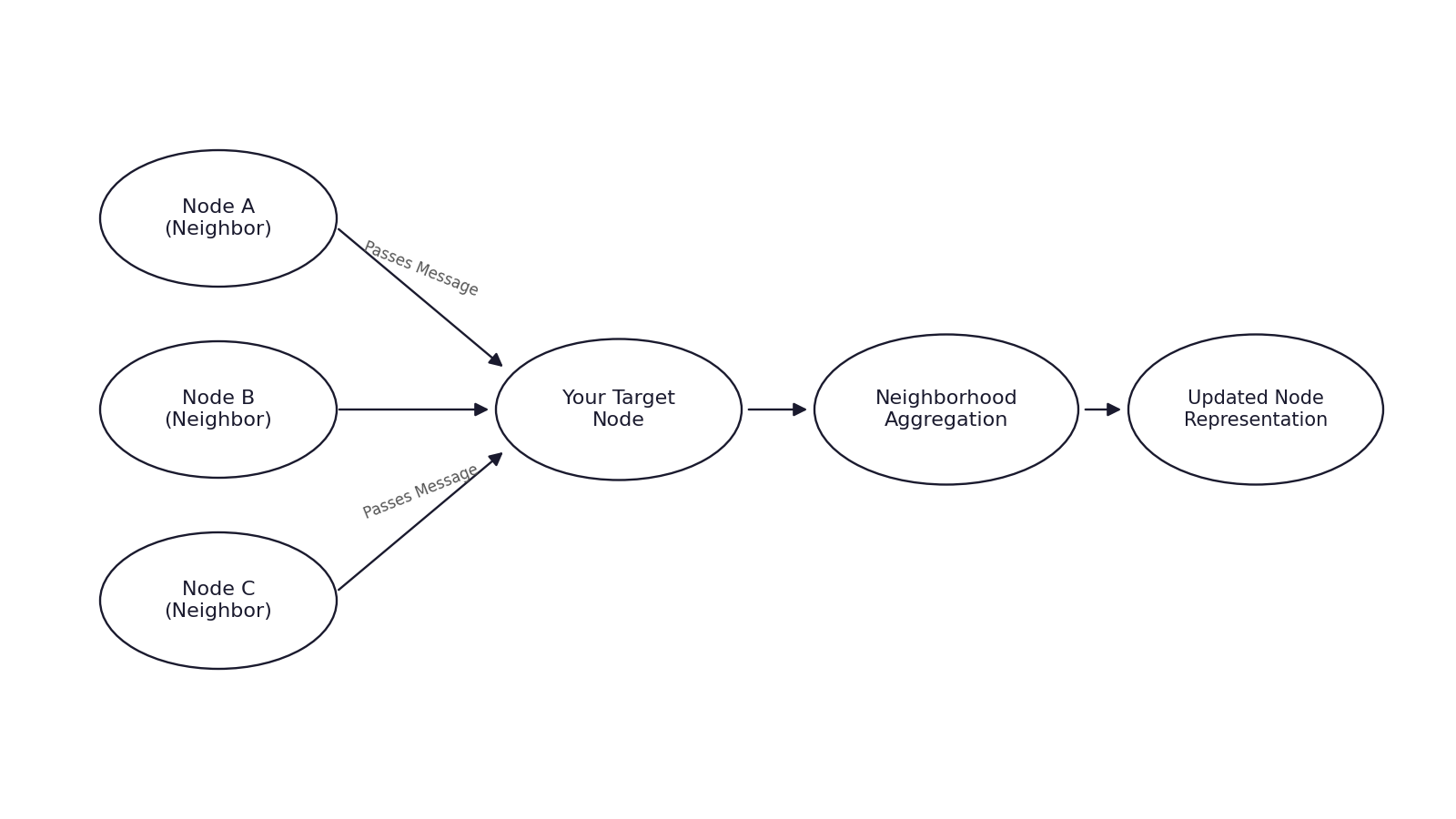
The key to graph neural networks is a concept called 'message passing' (or 'neighbourhood aggregation'). Suppose you were just a new citizen in a different neighbourhood, and you wanted to know about the culture of that neighbourhood. Talk to your immediate neighbours, listen to their opinions and update your own view of the town. Your neighbours are doing the same as their neighbours. The following diagram depicts the learning process of the core mechanism of Graph Neural Networks (GNNs), also known as message passing or neighbourhood aggregation. Let's take a look at how the pipeline works, step by step:
-Message Passing (Left): The nodes A, B and C are the immediate neighbours of your subject node. They bundle up their data profiles (features) - one by one - and send them across the network edges to your target node.
-Neighbourhood Aggregation (Middle): All the incoming messages are aggregated in the target node by the target node's neighbours. The GNN uses this data to combine it in a mathematical function (such as a sum, an average, or a maximum value) to give an integrated picture of the environment.
-The GNN takes that "mixed" neighbourhood summary and merges it with the original data on the target node (right).
An updated vector profile (node embedding) is sent to the target node. Not only does this last profile describe the node itself, but also the location of the node in the network and who is connected to it, enabling the AI to make highly contextual predictions.
The Three Types of GNN Predictions
There are three different types of GNN predictions. After GNN has received messages and learnt the structure of the graph, it can carry out three types of tasks:
-Node-level Classification: Predicting the property of a specific node. Problem: In a financial network, determine whether a user account is fraudulent or not.
-Edge-Level Prediction (Link Prediction): Forecasting if there is a link (should be a link) among two nodes. For instance, Instagram recommends a new user to connect to, or Amazon suggests a product you may want to purchase, based on similar users to those you have purchased.
-Graph-Level Classification: Classifying the whole graph as a whole. Example: In chemistry, the whole molecule is drawn as a graph. A GNN can be used to predict the toxicity or safety of that molecule in a novel drug.
Where GNNs are Changing the World
GNNs have quickly transcended from theory to the backbone of the industry giants:
-Revolutionising Drug Discovery: The discovery of a new medicine has traditionally required more than 10 years and billions of dollars. The attributes of GNNs, that are natural graphs (atoms linked together by chemical bonds), enable them to consider millions of molecular graphs within hours, identifying which ones are likely to fight diseases such as cancer.
-Powering Smart Maps and Logistics: Ever heard of how Google Maps can make accurate predictions of your Estimated Time of Arrival (ETA)? Graphs are used to represent traffic networks. GNNs simultaneously analyse real-time traffic flow data, intersections, and historical road data to optimise delivery routes and anticipate traffic jams before they occur.
-Cyber Security & Fraud Prevention: Financial fraudsters move money through numerous layers of shell companies and bank accounts. GNNs can identify these types of transaction paths easily and identify any suspicious circular flow or unusual network behaviours that traditional software would not be able to detect.
The Frontiers and Challenges Ahead
Despite their incredible power, GNNs aren't without hurdles. They are highly complex and face a notorious challenge called Over-Smoothing. If a GNN has too many layers, the constant "message passing" can cause all the nodes to end up looking exactly the same, ruining the model's accuracy.
Because of this, researchers worldwide are constantly designing new ways to optimise GNN architectures, using advanced mathematical heuristics, training frameworks, and even quantum-inspired algorithms - to make them faster, deeper, and more efficient.
Conclusion
We no longer live in an era of isolated data. As our world grows increasingly interconnected, the systems we build to analyse it must evolve too. Graph Neural Networks represent a massive leap forward, giving artificial intelligence the context, relationships, and structural sight it needs to navigate a connected universe.