The Israeli-Iranian Drone Wars: How Graph Neural Networks and AI Algorithms are Rewriting Battlefield Doctrine | Prof. Tarik A. Rashid | Dr. Tarik Ahmed Rashid
Public Research / 3 Min Read
The Israeli-Iranian Drone Wars: How Graph Neural Networks and AI Algorithms are Rewriting Battlefield Doctrine
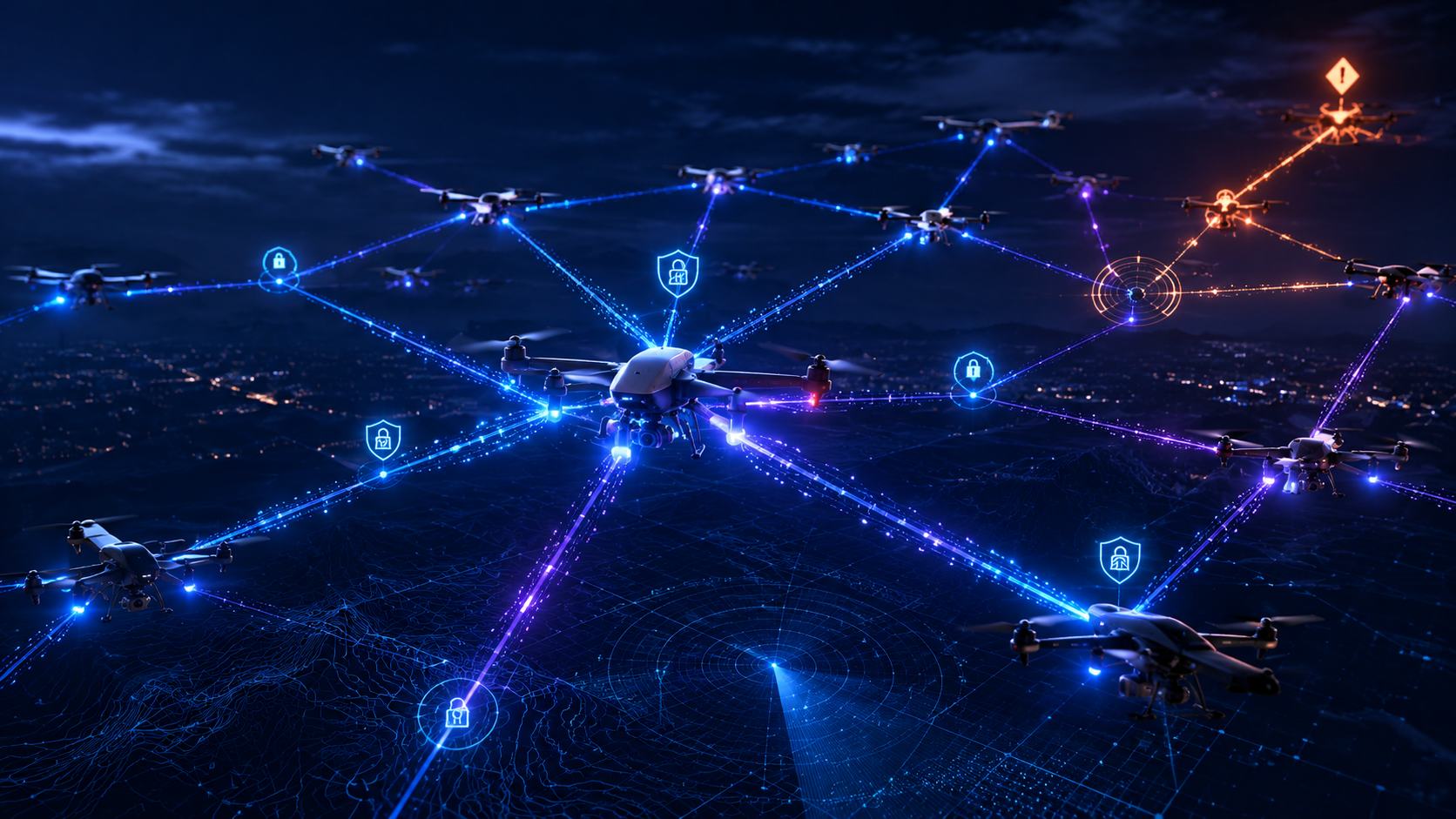
The modern battlefield is rapidly evolving, with physical battle increasingly becoming computational battle. In high-conflict areas, tensions such as the Israeli/Iranian conflict have become more of a hybrid environment, where control networks are attacked, in addition to material assets. Unmanned Aerial Vehicles (UAVs) are critical to these missions, but their light payload and communication methods are extremely susceptible to physical and cyber interference, including GPS spoofing, signal jamming, and Advanced Persistent Threats (APTs). (Maghdid, Rashid, and Askar, 2026) have developed an innovative approach that integrates Graph Neural Networks (GNNs) with the physical control of a swarm, thereby bridging the gap between network-level cyber defence and physical swarm coordination, to enable autonomous operation in the air.
UTILIZING Swarms as Dynamic Graphs
Intrusion Detection Systems (IDS) only analyse each data packet independently and fail to detect structural dependencies in a network. In this way, a drone swarm can be mathematically modelled as a dynamic graph where the drone nodes are connected by the wireless communications that they use. The researchers used an inductive graph-based framework called GraphSAGE, which is able to create node embeddings using samples and a few features from the local neighbourhood. Learning aggregate functions, not static global mappings, allows GraphSAGE to dynamically assess threat levels as swarm topology evolves during flight, and as nodes are removed from the swarm by electronic warfare.
Real-Time Threat Detection and Autonomous Countermeasures
The model's defence ability was then verified through the following scenarios: active jamming, identity spoofing, and persistent network intrusion, with common graph neural network variants used to test the model. The proposed GraphSAGE method was shown to be mathematically superior on all the important tactical metrics. It gained a high accuracy of 94.2%, an impressive average of 0.955 for the ROC-AUC, and a mean response latency of only 1.4 seconds compared to traditional Graphical Convolutional Networks (GCN) and Graphical Attention Networks (GAT). For localized threats, the GNN's classification output elicits immediate physical maneuvering to ensure swarm survivability:
1. Electronic Jamming: It involves node isolation and edge degradation, which can be indicated by this type of threat, and their dynamic topological rerouting and flight path adjustment to resolve this situation, so as to keep communication alive.
2. GPS Identity Spoofing: Telemetry anomalies and trust drift alarm are used to detect it and isolate the affected node, while the rest of the swarm uses neighbour-guided navigation.
3. Advanced Persistent Threats (APTs): Identified and blocked from spreading laterally, in the network, causing a cryptographic quarantine and a restructuring of the communication network.
The Bottom Line
Inductive graph architectures are capable of simultaneously processing real-time cybersecurity threats and adaptive situational manoeuvres with a response latency of 1.4 seconds and a detection rate of 94.2% in contested airspaces.
Implications for Autonomous Edge Systems
This integration proves the network's security does not need to be dependent on external, central operations centres. GraphSAGE's neighbourhood sampling mechanism also reduces memory overhead, allowing for the deployment of complex deep-learning inference models directly on the localised edge microcontroller with limited resources. Therefore, autonomous platforms in high-conflict environments can be completely self-aware and identify, isolate, and withstand cyber-physical attacks.
Bibliography
Maghdid, S.S., Rashid, T.A. & Askar, S. Graph neural networks at war: integrating cybersecurity and drone intelligence in the Israeli-Iranian conflict. J Comput Virol Hack Tech 22, 50 (2026). https://doi.org/10.1007/s11416-026-00631-2
Maghdid, S.S., Rashid, T.A. & Askar, S.K. Graph neural networks: Historical backgrounds, present revolutions, and conventionalization for the future. Int J Data Sci Anal 20, 5237–5299 (2025). https://doi.org/10.1007/s41060-025-00797-w
Rashid, T. A."Computer Science & Artificial Intelligence," 2026. Available: tarikrashid.com.